
Five villagers from Nacho area of the district, who went for hunting in a jungle were allegedly kidnapped by the PLA.
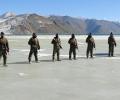
'The Arunachal border is not demarcated in that way, so there can be differing perceptions (between two sides)'


Though the Chinese find it necessary to oppose the visits of Indian leaders to Arunachal Pradesh, they want to keep the objections at a moderate level lest it cast a shadow on Narendra Modi's visit to China in May, says D S Rajan.

The alleged incident occurred on Friday in Nacho area of the district, their families said.

As of now, in the case of China's border dispute with India, China is not likely to lose much if it does not resolve the dispute. In fact, the unresolved border dispute has much to offer to China, says Sana Hashmi.
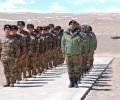
"There have been no intrusions or major face-offs in the area of responsibility of Eastern Command since the friction erupted in Ladakh," he said.
The notion that New Delhi can talk Beijing into engaging the hated 'Dalai clique' is entirely fanciful, says Ajai Shukla
China will cheerfully discuss human rights, environmental degradation and a raft of issues. But say the word 'Tibet' and the shutters come down, writes Ajai Shukla
In the slow-moving historical chess game that underlies the Sino-Indian border dispute, last month saw an important public acknowledgment in Beijing of an important concession from London that kicked the legs out from under the McMahon Line, which India claims as the Sino-Indian border in Arunachal Pradesh.
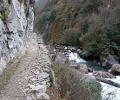
With China reacting sharply to government's plans to construct a border road in Arunachal Pradesh, Home Minister Rajnath Singh on Thursday sent a strong message, asserting that no one can warn India.
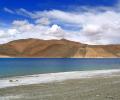
'It is pure luck that we did not have any body bags, otherwise things could have been nasty.'
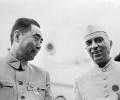
The Indians felt that if they acceded to Chinese claims in Ladakh, Beijing would simply be emboldened to press for further concessions in the future. A revealing excerpt from India And The Cold War.
Though the Bharatiya Janata Party has frequently raised the issue of Chinese incursions in Parliament, Nabam Rebia was the first MP from the ruling Congress party to support the allegation.
'It is certainly time for New Delhi to open up. Not only should it go ahead at full steam with the roads to the LAC, but the government must also allow tourists to visit these stunningly beautiful areas of Indian territory.'
Seeking special financial packages for the north-eastern state, Kiren Rijiju and Tapir Gao also urged the Prime Minister to consider implementation of their demand that the status of populated areas of both sides of the McMahon Line should not be altered to enable a permanent solution to the border dispute with China.
Nabam Rebia said the Chinese army had demolished a Buddha statue in Tawang and that constant incursions by Chinese troops had instilled a sense of insecurity in the people of Arunachal Pradesh.
"What to talk of Tawang, the entire Arunachal Pradesh is on this side of McMahon line and is an indivisible part of India."

'It is a pattern of behaviour of the Chinese that whenever a Chinese leader visits India or an Indian leader visits China, some incidents take place.' 'When Modi visits China, we should look out for some similar demonstration by the Chinese.'

Situated at a height of 15,200 feet above sea level, the pass sits on the top of a craggily formed Himalayan range that separates the Tibetan plateau from the Indian sub-continent.

China has chosen to keep New Delhi guessing, while retaining for itself the option of constantly changing facts on the ground and shifting the LAC westwards -- the strategy called 'salami slicing', notes Ajai Shukla.
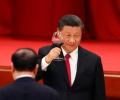
After the Ladakh fiasco where Xi Jinping did not expect the Indian Army to resist his land-grabbing tactics, he has to save face before his colleagues in the Communist party.' To bring the threat of a mega-dam to the northern Indian border is a clever move, observes Claude Arpi.
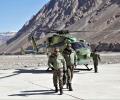
'This reluctance to respond forcefully to Chinese PLA provocations and outright aggression has as much to do with Prime Minister Modi personally, as with the institutional mindset of the MEA or even the Indian Army.' 'They are scarred by the 1962 War and are still cowed by China.'

'Manmohan Singh's fond hope of avoiding conflict over territory by 'making borders irrelevant' is increasingly difficult to realise in a world where institutional restraints on aggression are weakening and the new game in town is unalloyed power play,' notes T N Ninan.
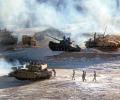
'India cannot allow Beijing's policy of stabilising and destabilising the border at will to perpetuate its own ends.' A riveting excerpt from Manish Tiwari's 10 Flashpoints; 20 Years National Security Situations That Impacted India.

'At critical moments an inability to take tough decisions resulted in potentially far-reaching solutions slipping out of our grasp.' 'If similar opportunities come Narendra Modi's way will he act differently?' asks Karan Thapar.

China has long coveted Arunachal Pradesh, which it calls Southern Tibet. But, as Venkataraghavan Subha Srinivasan explains, in 1947, the present state of Arunachal Pradesh constituted the North East Frontier Tract of Assam. When India adopted its Constitution on 26 January 1950, NEFT became 'a separate politico-administrative entity' although it was constitutionally still a part of Assam. Its administration was brought directly under the President of India with the Governor of Assam acting as his agent. A revealing excerpt from his book The Origin Story of India's States.

'Chinese troops are not geared to fight Indian troops who are battle hardened and acclimatised and are far more hardy.'

Indian elections are won and lost on 'negative' imageries and campaigns - but not certainly on 'negativity' as a political trait and electoral creed, asserts N Sathiya Moorthy.
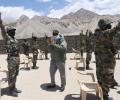
Only he, with his tremendous political capital and personal stature, can pull it off, observes B S Raghavan, the veteran civil servant.

'Tibet remains a prickly issue between the giant Asian nations. China still claims more than 80,000 sq kilometres of Indian territory in the Northeast. Why? Just because Beijing refuses to acknowledge the McMahon line which separates India and Tibet, and this, simply because the 1914 Agreement delineating the border was signed by the then government of independent Tibet with India's then foreign secretary (Sir Henry McMahon),' says Claude Arpi.

'We are facing the most critical military situation with China in the last 50 years.'
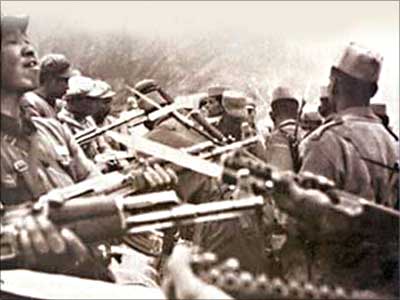
From March 1959 to March 1962, the PLA fought 12 major battles in central Tibet which was seen as an opportunity to train China's soldiers, notes Ajai Shukla.
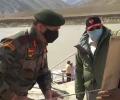
'We should not minimise the seriousness of Chinese encroachments because their perception is different.' 'Nor should we fall into the trap of accepting so-called 'buffer zones' in areas of overlapping claims. We cannot have buffer zones in our own territory,' asserts Ambassador Shyam Saran, a former foreign secretary.

China's state-run media on Saturday reiterated the country's claim on Arunachal Pradesh, contending that the area is under "illegal Indian occupation".

China will flood direct flights to India with wholesale takeaways of the authentic stuff; Indian businessmen will fight for the commission and the consumers for the cuisine, predicts Sunanda K Datta-Ray.
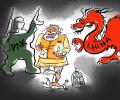
'China need not worry about a truly 'resurgent India'.' 'It's not going to happen.'

Claude Arpi's fascinating account of the Dalai Lama's arrival in Tawang in March 1959.

The Tibetan nation still lives under the yoke of the Chinese Communist Party, and Beijing today has a guilty conscience; this creates a great uneasiness for Xi Jinping and his colleagues observes Claude Arpi.
